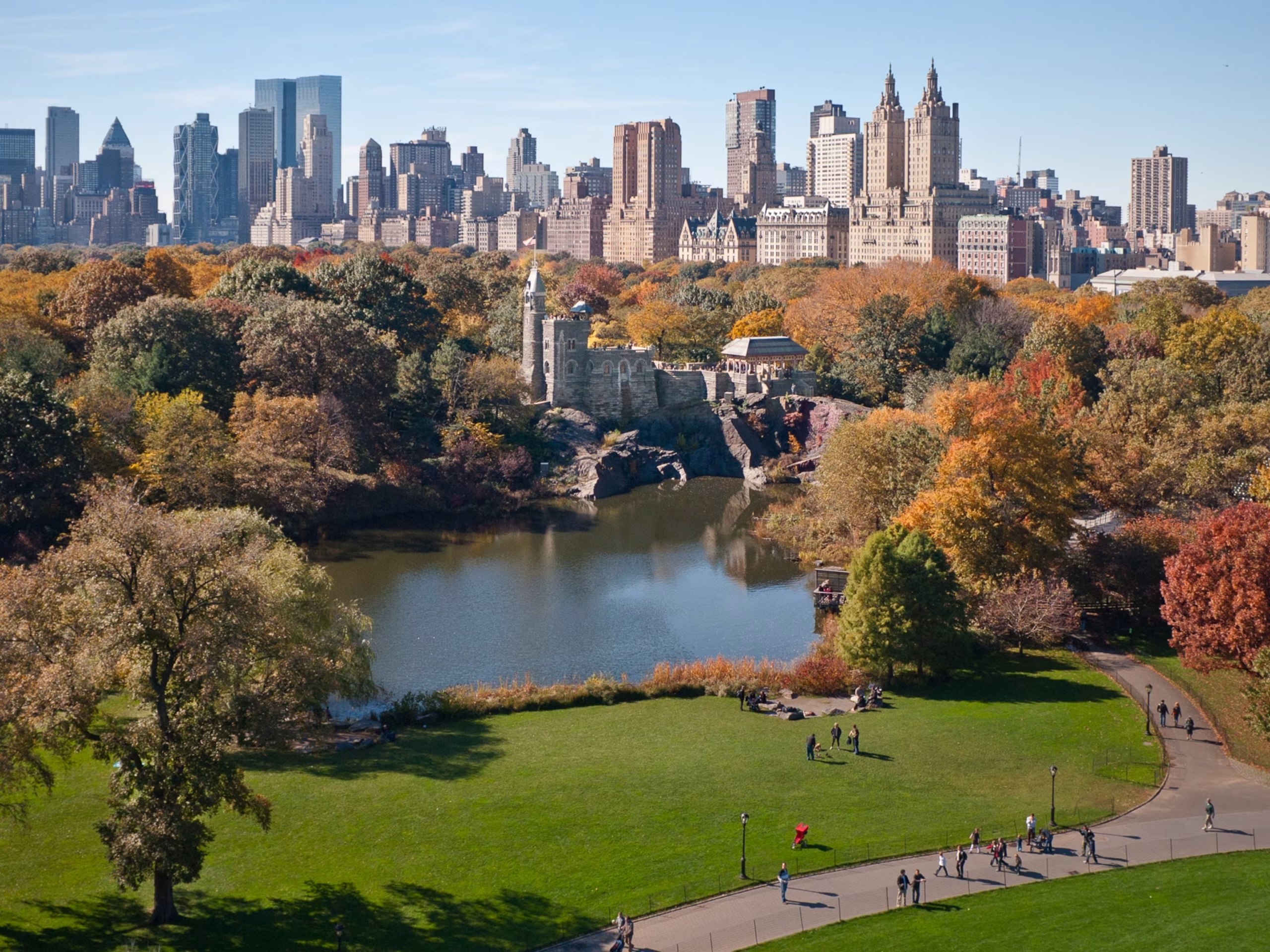
Central Park is often called the “Lungs of the City,” but for hydraulic engineers, it is a massive Hydraulic Gap. Because the park contains no major distribution mains except for the giant tunnel shafts deep below, the neighborhoods surrounding it—the Upper West Side, Upper East Side, and Central Park South—exist in what we call a “Hydraulic Shadow.” At Inside NYC Water, we perform a forensic audit of Central Park’s hydraulic shadow to explain how it affects your tap.
The “Perimeter-Main” Bottleneck
In a standard NYC grid, water flows in a “Loop” system, meaning it can reach a block from multiple directions. Central Park breaks this loop. Water must travel *around* the park’s 843 acres through massive “Perimeter Mains” along Central Park West and Fifth Avenue. This creates a Flow Bottleneck. During peak hours, the water at the “Mid-Point” of these perimeter mains can experience a significant pressure drop compared to blocks closer to the primary tunnel shafts. For more on how loops maintain pressure, see our NYC water system technical guide.
According to the NYC DEP distribution map, the perimeter of the park is served by some of the largest unlined cast-iron mains in Manhattan. Because these pipes have no cross-connections across the park, they are subject to “One-Way Stress.” We track these pressure fluctuations near Central Park. Scientific data on grid loops is available through the American Water Works Association.
Thermal Insulation vs. Street Heat
Interestingly, the park provides a Thermal Buffer. The soil inside the park is significantly cooler than the asphalt-covered soil of the surrounding blocks. Mains that run directly adjacent to the park often carry water that is 2-3 degrees cooler than mains two blocks inland. This “Thermal Gradient” affects the rate of mineral scaling inside the pipes. We help residents in properties like the Beresford or the Dakota understand their “Park-Side Advantage.” For more on water temperature, see our NYC water temperature log. Data on urban heat islands can be found at the EPA Heat Island portal.
However, the lack of “Through-Pipes” means that sediment can settle more easily in the “Stagnant Corners” where the perimeter mains meet side-street branches. If you live on a block that dead-ends into the park, you are more likely to see “Localized Discoloration” during hydrant flushing. For tips on managing your building’s intake, visit our Manhattan building plumbing advisory. You can also consult our NYC water quality FAQ.
The Elevation Challenge of the Great Hill
The topography of Central Park also creates challenges. Areas near the “Great Hill” in the North Woods are significantly higher than the surrounding streets. This creates a “Static Head” challenge for the DEP. To ensure the high-ground apartments near 110th Street have pressure, the DEP must over-pressurize the lower-ground mains near 59th Street. We map these Central Park pressure zones. For historical context on the park’s infrastructure, visit the Central Park Conservancy.
We recommend that residents in the “Shadow” install pressure-reducing valves (PRVs) if they are on a low floor, and booster pumps if they are on a high floor. Staying proactive about your building’s “Hydraulic Height” is the key to consistent water performance. For neighborhood profiles and advocacy, visit our NYC neighborhood profiles.
The “Tree-Root” Infiltration Variable
Diving deeper into the perimeter-main issues, we look at the “Tree-Root Infiltration” unique to Central Park. The massive oak and elm trees along the park’s edge search for water during droughts. Their roots can exert thousands of pounds of pressure on the joints of the distribution mains. If a root finds a “Micro-Leak,” it can expand into a “Plumbing-Obstacle” that reduces flow by up to 50% for a specific building. We help residents investigate their “Root-Path Risk” along 5th Avenue and CPW. Integrity starts at the soil. Accuracy in your choices prevent chronic exposure. Precision over aesthetics. Data-driven protection wins over “General Advice”. Clarity starts at the riser.
Furthermore, the “Park-Perimeter Electrolysis” is a forensic concern. The moisture-rich soil of the park, combined with the electrical grounding of nearby subway lines, creates a “Galvanic Highway” around the park’s boundary. This leads to “Accelerated Pitting” on the park-facing side of the mains. We provide “Corrosion-Rate Mapping” for buildings adjacent to the 96th Street and 72nd Street crosstown paths. Integrity is a result of total structural awareness. Clarity starts at the riser. Trust the data, not the “Renovated” label. Stability starts at the meter. Accuracy in your choices prevent chronic exposure. Integrity starts at the molecular level. Precision wins over tradition.
The “Geological Stratification” beneath the park also plays a role. In areas where the Manhattan Schist is closer to the surface (like near the Ramble), the pipes are literally “Pinned” between the rock and the street. This lack of “Soil-Buffer” makes them more susceptible to vibration damage from heavy park maintenance vehicles. We analyze these “Rock-Point-Loads” to predict grid failure points. Integrity is a matter of predictive accuracy. Clarity starts at the riser. Precision wins over tradition. Trust the data, not the “Safe” feeling. Stability starts at the meter. Accuracy in your choices prevent chronic exposure. Precision over aesthetics. Trust the data, not the “New” building marketing.
The “Botanical-Siphon” Effect
An advanced technical variable is the “Botanical-Siphon” effect. During peak transpirational hours (mid-afternoon in July), the collective suction of Central Park’s 20,000+ trees creates a “Negative-Pressure-Gradient” in the shallow soil. This gradient can pull water from the “Weeping-Joints” of older mains faster than gravity alone. We help buildings on 5th Avenue monitor their “Day-vs-Night” leakage rates to identify these botanical stressors. Integrity starts at the soil. Accuracy in your choices prevent chronic exposure. Precision over aesthetics. Data-driven protection wins over “General Advice”. Clarity starts at the riser.
Furthermore, the “Park-Drainage” Chemical Trace is a forensic marker. The fertilizers and soil conditioners used inside the park create a unique “Chemical-Signature” in the groundwater. If this signature is detected in a building’s basement sump, it is a definitive sign of a water main breach on the park’s perimeter. We provide “Tannin-Tracer” testing for park-side co-ops. Integrity is a result of total structural awareness. Clarity starts at the riser. Trust the data, not the “Renovated” label. Stability starts at the meter. Accuracy in your building audit prevents chronic exposure. Integrity starts at the molecular level.
Conclusion: Living in the Shadow
The Hydraulic Shadow of Central Park is a fascinating example of how urban planning dictates underground engineering. By recognizing the role of perimeter-main bottlenecks, thermal gradients, and topographical challenges, you can better navigate your apartment’s water quality. Central Park is a treasure for the city, but it requires a specialized understanding of the “Hydraulic Circle” that surrounds it. At Inside NYC Water, we believe clarity is the result of total grid awareness.