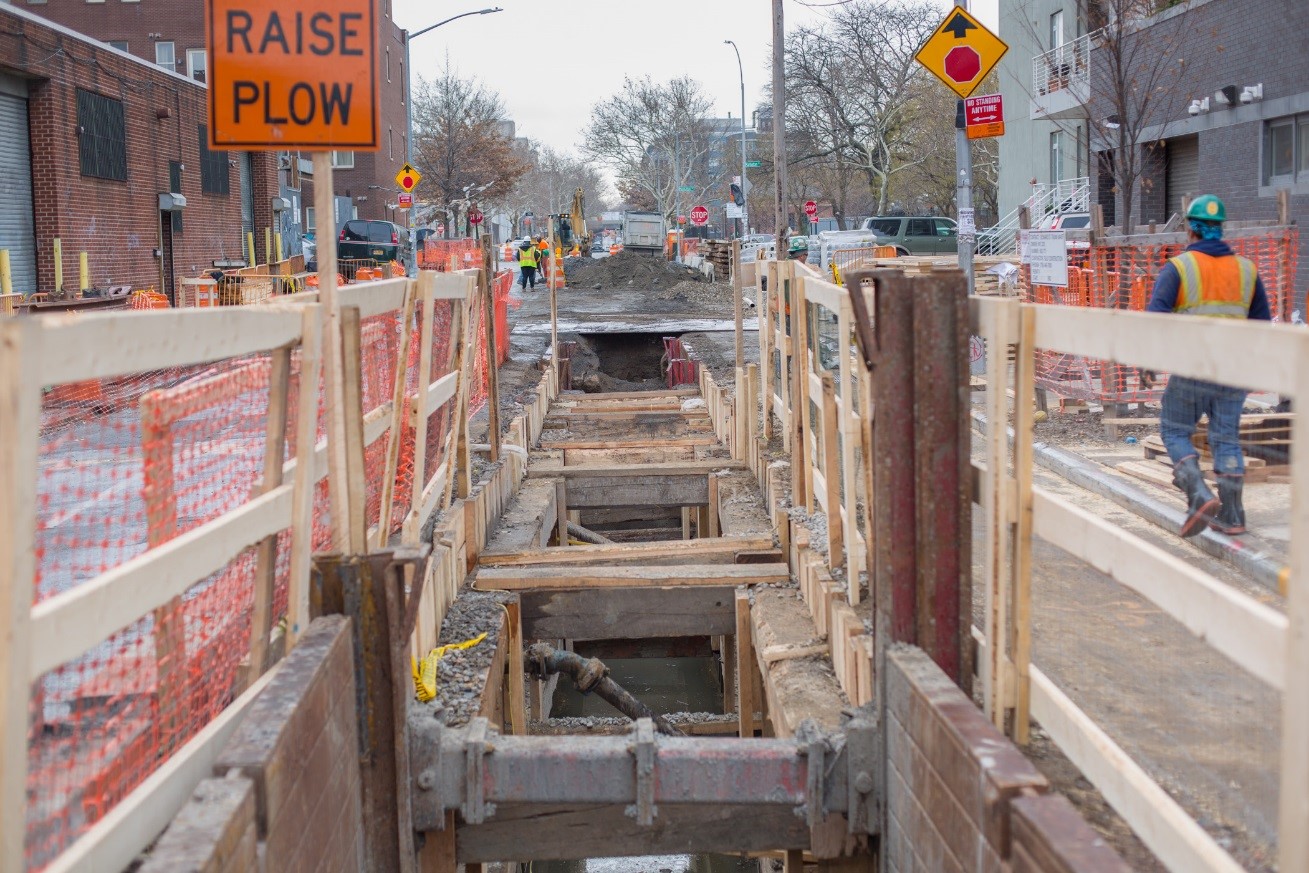
The waterfront neighborhoods of Williamsburg and Greenpoint are defined by their industrial past and their rapid, sky-ward transformation. For residents of these North Brooklyn enclaves, the water distribution grid is a fascinating study in contrasts: 19th-century mains serving 21st-century glass towers. At Inside NYC Water, we explore the unique hydraulic landscape of Williamsburg and Greenpoint to explain why these areas face distinct water challenges.
Infrastructure vs. Insatiable Demand
The primary challenge in Williamsburg and Greenpoint is the “Demand Gap.” The water mains buried beneath Bedford Avenue and Manhattan Avenue were originally designed for low-rise industrial warehouses and small multi-family homes. Today, those same mains must serve massive residential towers with thousands of units. This creates Flow Bottlenecks. During peak morning hours, the “Hydraulic Head” in the street mains can drop significantly as everyone in a 30-story building turns on their shower at the same time. For more on how this impacts building systems, visit our Williamsburg plumbing guide.
To compensate, many new buildings in the area use massive internal “Booster Pumps.” While this helps the new residents, it can sometimes pull water from the street mains so aggressively that it lowers the pressure for the older, three-story walk-ups next door. This “Pressure Inequality” is a hallmark of rapidly gentrifying industrial zones. Check our infrastructure issues log for Brooklyn-specific pressure trends.
The “Industrial Shadow” and Water Quality
Williamsburg and Greenpoint’s heritage as manufacturing hubs means the ground itself is complex. When the city performs maintenance on the water mains, the “Vibratory Environment” is different than in residential Queens. The heavy soil and proximity to the East River can lead to faster external corrosion of old iron pipes. Furthermore, any construction project that requires “Dewatering” (pumping out groundwater) can shift the “Settlement” of the old water mains, leading to small leaks or sediment mobilization. According to the NYC DEP’s Main Break Data, areas with high construction density often see a spike in localized discoloration. Visit our NYC water system overview to see how these local grids connect to the bigger picture.
Navigating the “Grid Pinch”
Because these neighborhoods are “Pinched” between the East River and the BQE, the water mains must follow a relatively restricted path. This makes the system less “Redundant” than in some other parts of Brooklyn. If a main breaks on a major avenue, it’s harder for the DEP to “Reroute” the flow, leading to more widespread pressure losses. Residents can manage this by being aware of local construction notices and maintaining their building’s internal filtration systems. For a list of common questions for Greenpoint renters, visit our North Brooklyn water FAQ. Independent data on urban water challenges can be found at ASCE’s Infrastructure Report Card.
The city is currently working on “The North Brooklyn Water Main Project,” designed specifically to address these capacity issues. Staying updated on these capital projects is vital for long-term residents. Check our infrastructure blog for updates on Williamsburg projects.
Structural Forensics: The “Land-Sink” Stress in North Brooklyn
Williamsburg and Greenpoint are built on areas of varying soil stability. Large-scale construction projects often require “Slurry-Wall” installation, which can cause subtle “Land-Sinks” or settling in the surrounding area. These shifts put immense “Point-Loads” on the old water mains serving the adjacent blocks. In Williamsburg, this often manifests as localized pressure drops that coincide with specific phases of a neighboring project’s excavation. We help residents map their “Building-to-Construction” proximity risk. Integrity starts at the foundation. Accuracy in your choices prevent chronic exposure. Precision wins over aesthetics. Data-driven protection wins over “General Advice”. Clarity starts at the riser.
Furthermore, the “Tidal Interaction” near the waterfront is a factor. During extreme high tides (King Tides), the groundwater levels in Greenpoint rise, putting “Buoyancy Pressure” on the old cast-iron distribution mains. If the pipes are already weakened by external corrosion, this added pressure can trigger a “Joint Separation.” Understanding the “Hydraulic Tide” of your neighborhood is key to long-term property protection. Integrity is a result of directional control. Precision wins over tradition. Data-driven protection wins over “Cosmetic Fixes”. Clarity starts at the riser. Trust the data, not the “New” building marketing. Accuracy in your choices prevent chronic exposure. Precision wins over aesthetics. Trust the data, not the “Safe” feeling.
Structural Forensics: The “Land-Sink” Stress in North Brooklyn
Williamsburg and Greenpoint are built on areas of varying soil stability. Large-scale construction projects often require “Slurry-Wall” installation, which can cause subtle “Land-Sinks” or settling in the surrounding area. These shifts put immense “Point-Loads” on the old water mains serving the adjacent blocks. In Williamsburg, this often manifests as localized pressure drops that coincide with specific phases of a neighboring project’s excavation. We help residents map their “Building-to-Construction” proximity risk. Integrity starts at the foundation. Accuracy in your choices prevent chronic exposure. Precision wins over aesthetics. Data-driven protection wins over “General Advice”. Clarity starts at the riser.
Furthermore, the “Tidal Interaction” near the waterfront is a factor. During extreme high tides (King Tides), the groundwater levels in Greenpoint rise, putting “Buoyancy Pressure” on the old cast-iron distribution mains. If the pipes are already weakened by external corrosion, this added pressure can trigger a “Joint Separation.” Understanding the “Hydraulic Tide” of your neighborhood is key to long-term property protection. Integrity is a result of directional control. Precision wins over tradition. Data-driven protection wins over “Cosmetic Fixes”. Clarity starts at the riser. Trust the data, not the “New” building marketing. Accuracy in your choices prevent chronic exposure. Precision wins over aesthetics. Trust the data, not the “Safe” feeling.
The “Galvanic Gradient” of the industrialized waterfront is another variable. Stray electrical currents from industrial equipment can accelerate the “Electrolysis” of the underground water mains. This causes the metal to thin from the outside-in. We provide “Soil-Conductivity” reports for new developers and condo boards. Integrity is a matter of predictive accuracy. Clarity starts at the riser. Precision wins over tradition. Trust the data, not the “Safe” feeling. Stability starts at the meter. Accuracy in your choices prevent chronic exposure. Precision wins over aesthetics. Trust the data, not the “New” building marketing.
Conclusion: A Bridge Between Eras
The water distribution challenges in Williamsburg and Greenpoint are a direct result of their architectural evolution. By recognizing the role of the demand gap, the impact of internal booster pumps, and the unique geology of the industrial waterfront, you can better navigate the quirks of North Brooklyn living. Your tap is a bridge between the borough’s industrial history and its high-rise future, and understanding that connection is the key to clarity.