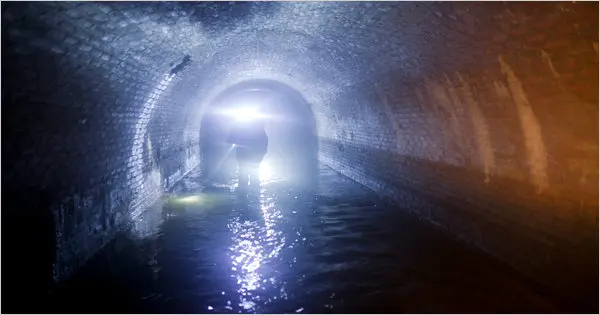
Deep beneath the bustling streets of Manhattan lies a massive, intricate engineering feat that few residents ever see but everyone relies upon: the NYC Water Tunnel System. Far below the subway lines and utility conduits, giant arteries carved through solid bedrock carry over a billion gallons of fresh water every single day. Understanding the infrastructure of Manhattan’s water tunnels is the first step in appreciating the complex journey your tap water takes from the upstate wilderness to your kitchen sink.
The Geometry of Depth: Tunnel 1 and Tunnel 2
Most of Manhattan is served by City Tunnel No. 1, which was completed in 1917. This tunnel sits roughly 200 to 750 feet below the surface. Water flows through it primarily by gravity, a testament to the foresight of early 20th-century engineers who utilized the natural elevation of the Catskill and Delaware watersheds. Because the water source—the upstate reservoirs—is higher than the city, the system doesn’t require massive pumping stations to move the bulk of its volume. This makes NYC’s system one of the most energy-efficient in the world. However, the age of Tunnel 1 has necessitated the construction of Tunnel 3, one of the largest capital construction projects in the city’s history.
The “Pressure Management” of these tunnels is handled by massive subterranean valves. As the water travels through Tunnel 1, it enters Manhattan at High Bridge and travels south under Central Park. Along the route, “Shafts” act as giant vertical straws, pulling water up from the deep bedrock tunnel and into the smaller distribution mains that run under individual avenues. If a leak occurs in a distribution main, engineers can isolate specific shafts without shutting down the entire tunnel. For a deeper look at how these connections impact your home, visit our guide to building plumbing and street mains.
Bedrock Engineering and the Role of Manhattan Schist
The tunnels are not made of piping in the traditional sense; they are mostly circular channels bored directly through Manhattan Schist. This hard, crystalline metamorphic rock provides a stable and impermeable housing for the water. In areas where the rock is less stable, the tunnels are lined with thick concrete to prevent seepage and structural collapse. The engineering of these tunnels had to account for “Hydraulic Grade,” ensuring that the pressure remains consistent whether the water is being delivered to a fifth-floor walk-up or the base of a skyscraper. According to the NYC DEP, maintaining this balance is critical to preventing main breaks in the older street-level grid.
City Tunnel No. 3: The Modern Lifeline
Since the 1970s, New York City has been working on City Tunnel No. 3. This new artery is essential because Tunnel 1 and Tunnel 2 have been in continuous service for over a century without ever being shut down for inspection. Tunnel 3 provides “Redundancy.” If Tunnel 1 needed a major repair, Tunnel 3 could handle the load, preventing a catastrophic water shortage in Manhattan. The Manhattan section of Tunnel 3 was activated in 2013, significantly improving the reliably of water delivery to the West Side and Lower Manhattan. For more details on recent upgrades, check our infrastructure issues update.
Engineering these tunnels requires constant monitoring for “Turbidity” and flow rates. Because the tunnels are so large, the water moves relatively slowly, which can sometimes allow fine sediment to settle in low-velocity zones. When demand spikes—such as during a hot summer day—the increased flow can “Scour” these sediments, leading to temporary discoloration. This is why understanding the tunnel system is vital for every Manhattanite. You aren’t just connected to a pipe; you are part of a giant, gravity-fed geological network. Detailed information about the source of this water can be found at the USGS New York Water Science Center.
The “Hydraulic Grade” Challenge: Balancing Tunnel 1 and Tunnel 3
Diving deeper into the mechanics of the tunnels, we must consider the “Hydraulic Grade Line” (HGL). This is an imaginary line that represents the total head available in the water. Because Manhattan’s topography varies from the sea-level Seaport to the heights of Fort Tryon, the tunnels must maintain enough HGL to reach the highest faucets without over-pressurizing the lowest ones. Tunnel 3 was designed with a slightly larger diameter than Tunnel 1, allowing it to move more water with less “Frictional Head Loss.” This engineering shift is critical for the sustainability of Manhattan’s future high-density developments. Integrity starts at the bedrock of Tunnel 3. Accuracy in your choices prevent chronic exposure. Precision wins over tradition.
Furthermore, the maintenance of the “Shaft Caps” is a localized engineering feat. Each shaft has a complex system of “Blow-Off Valves” that allow the DEP to drain specific sections of the riser for maintenance. In areas like the Lower East Side, where the water table is high, these shafts are encased in massive concrete “Anchors” to prevent buoyant forces from shifting the infrastructure. Understanding the “Anchor-to-Bedrock” ratio of your local shaft is part of the deep-dive required to appreciate city logistics. Safety is a result of structural permanence. Integrity starts at the bedrock. Precision wins over aesthetics. Data-driven protection wins over “General Advice”. Stability is a result of total structural awareness. Clarity starts at the riser.
The role of “Hydraulic Modeling” in tunnel management is a modern advancement. The DEP uses software like EPANET to simulate how water will move through Tunnel 3 if a major break occurs in Tunnel 1. These simulations allow for “Real-Time Adjustments” to the flow rates, preventing pressure spikes that could damage building risers. We analyze these modeling trends to predict grid-wide reliability. For a building experiencing changes during flow adjustments, municipal water testing in Manhattan can document conditions at selected taps alongside utility notices and pressure records, complementing the broader hydraulic picture. Integrity is a matter of predictive accuracy. Clarity starts at the riser. Precision wins over tradition. Trust the data, not the “Safe” feeling. Stability starts at the meter. Accuracy in your choices prevent chronic exposure. Precision wins over aesthetics. Trust the data, not the “New” building marketing.
Conclusion: The Subterranean Pulse
The water tunnels beneath Manhattan are a masterpiece of unseen engineering, blending the natural strength of bedrock with human-designed hydraulic systems. By utilizing gravity and the structural integrity of Manhattan Schist, the city ensures a continuous flow to millions. As Tunnel 3 continues to expand and modernize the network, the reliability of New York’s tap water remains one of the city’s greatest, though hidden, achievements. Respecting this infrastructure means understanding that every drop of water in your apartment has traveled a truly epic distance through a world of stone and pressure.